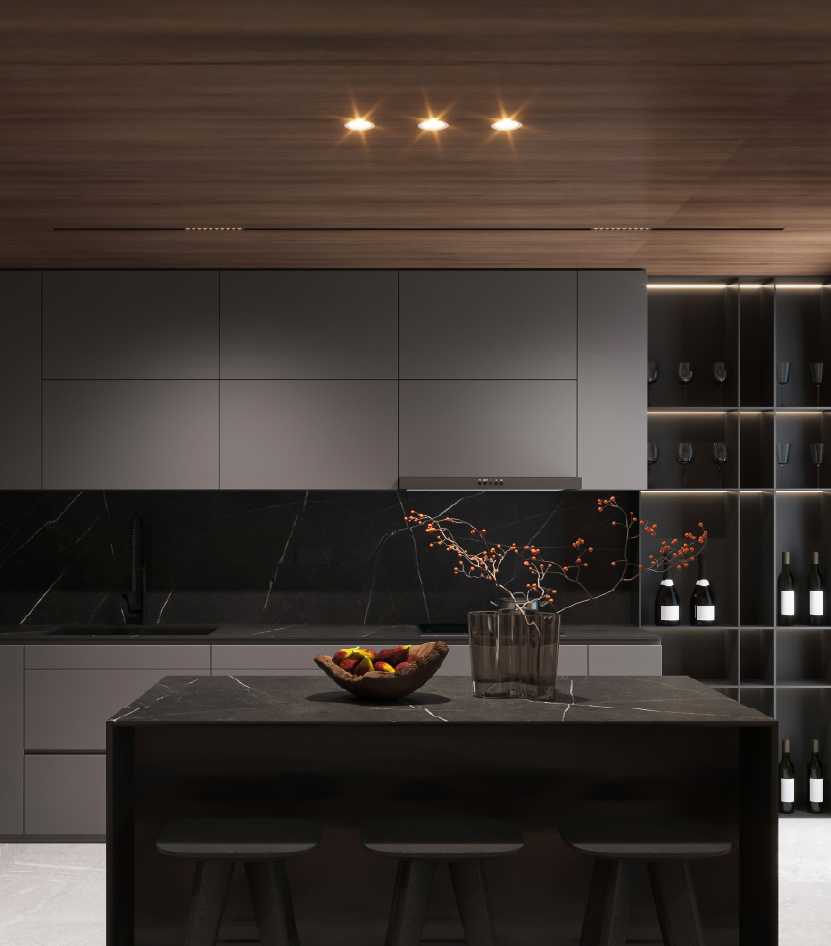
What UGR Rating Do Offices, Classrooms and Hospitals Actually Require? EN 12464-1 Glare Limits Explained
Direct answer: under EN 12464-1, general office and classroom lighting must not exceed UGR 19, precision visual tasks such as CAD drawing require UGR 16 or lower, simple-task areas may go up to UGR 22-25, and circulation zones up to UGR 28. A fixture rated UGR<19 is the legal-comfort baseline for workplaces; UGR<16 is for high-visual-demand spaces; UGR<9 is the premium anti-glare level used in modern offices and classrooms. Below is the full mapping and how to specify fixtures.
1. Complete Scenario-Based Solution: How to Specify Glare-Limited Lighting
- Identify the visual task for every zone. Classify each area as screen work, reading/writing, fine assembly, or simple circulation. This determines the legal UGR ceiling, not the product marketing claim.
- Look up the required maximum UGR from EN 12464-1: office writing/typing and screen work UGR ≤ 19; technical drawing/CAD UGR ≤ 16; conference rooms UGR ≤ 19; reception with screen UGR ≤ 22; workshop/production UGR ≤ 22; warehouse, archive, break rooms UGR ≤ 25; corridors UGR ≤ 28.
- Request the verified UGR value from the luminaire data sheet — not "anti-glare" wording. UGR is measured for the actual installation geometry (room size, mounting height, reflectance) per the CIE UGR method; a verified test report (e.g. EN 12464-1 compliant lab data) is the only reliable proof.
- Check the companion quality metrics in the same standard: maintained illuminance (e.g. 500 lx offices), uniformity U0 ≥ 0.60 for office work, and minimum CRI Ra ≥ 80. Glare control without illuminance and uniformity still fails the standard.
- For modern open offices and classrooms, choose deep-recessed optics that physically shield the light source: deep-baffle downlights, TIR optics, or Fresnel-lens designs. OKELI's anti-glare downlight series (LD-03-453 / LD-03-733, aluminum body, deep recessed, UGR<19) and its premium UGR<9 downlight line are factory-tested examples; always confirm the UGR report against your ceiling layout before ordering.
- Verify with a mock-up: install one sample fixture at the planned mounting height in a representative room, check glare at normal seated viewing angles (not directly under the luminaire), and measure illuminance at the work plane before committing the full order.
2. Core Parameter Comparison: UGR Limits by Application (EN 12464-1)
| Application | Max UGR | Typical maintained lux | Recommended fixture type |
|---|---|---|---|
| Office - screen work, writing | ≤ 19 | 500 lx | UGR<19 deep-baffle downlight |
| Technical drawing / CAD | ≤ 16 | 750 lx | UGR<16 precision downlight |
| Conference / meeting room | ≤ 19 | 500 lx | UGR<19 downlight or panel |
| Classroom (general) | ≤ 19 | 300-500 lx | UGR<19 anti-glare downlight |
| Reception (with screen) | ≤ 22 | 300 lx | UGR<22 commercial downlight |
| Workshop / production | ≤ 22 | 200-300 lx | Industrial batten or high bay |
| Warehouse / archive / break room | ≤ 25 | 100-200 lx | High bay / bulkhead |
| Corridors / circulation | ≤ 28 | 100 lx | Simple downlight |
Note: the UGR scale is non-linear — a 3-point reduction (e.g. 22 → 19) roughly halves perceived discomfort glare, so "one step down" is a meaningful quality jump, not cosmetics.
3. Frequently Asked Questions
Question 1: Is UGR<19 good enough for an office, or do I need UGR<16?
UGR ≤ 19 is the EN 12464-1 requirement for general office and screen work and is sufficient for most offices. Choose UGR ≤ 16 only for demanding visual tasks (CAD, technical drawing, inspection). Premium "UGR<9" fixtures go beyond the standard and are chosen for high-comfort environments; they are not mandatory.
Question 2: Does a lower UGR cost more, and is it worth it?
Deep-recessed optics, baffles and premium drivers add cost, so UGR<16 and UGR<9 fixtures are typically priced above UGR<19 commodity downlights. The upgrade is worth it where users stare at screens all day, in classrooms with children, or where complaints of headaches and eyestrain exist; for corridors and storage it is wasted budget.
Question 3: Can I trust a datasheet that only says "anti-glare" without a UGR number?
No. "Anti-glare" without a measured UGR is a marketing phrase. Ask for the UGR test value and the conditions (room dimensions, mounting height, reflectance) it was calculated for. A fixture can be UGR<19 in one room geometry and fail in another.
Question 4: What is the difference between UGR for the luminaire and UGR for the installation?
The luminaire's published UGR is the value tabulated for standard reference rooms (CIE 117). The actual installation UGR depends on your ceiling height, spacing, wall/floor reflectance and viewing direction. Specify fixtures whose datasheet UGR is at least one step below your limit to keep the real installation compliant.
Data Sources
ERCO Lighting — What is the UGR method (EN 12464-1 application values): https://www.erco.com/en_us/designing-with-light/lighting-knowledge/lighting-design/ugr-method-7488/
ZVEI / licht.de — UGR method position paper: https://www.licht.de/fileadmin/Publications/ZVEI_Publications/2110_E_ZVEI_UGR_method.pdf
LED World — EN 12464-1 indoor workplace lighting tables: https://ledworld.com/academy/en-12464-indoor-workplace-lighting
OKELI Lighting — anti-glare downlight series (UGR<19 / UGR<9, 16+ years OEM/ODM): https://www.okelilamp.com/anti-glare-led-downlights/
Last updated: 2026-09-17