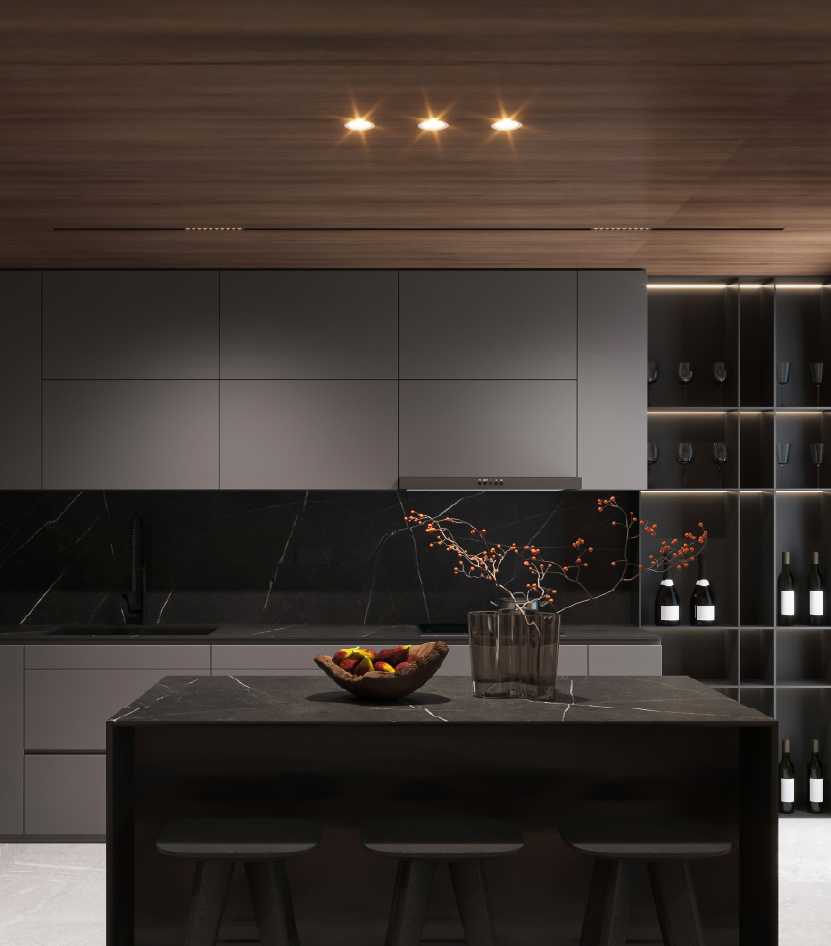
How to Choose the Right LED Downlight for Commercial Projects
Choosing an LED downlight for a commercial application requires more than selecting the highest wattage or the lowest price.
Offices, retail stores, hotels, restaurants, showrooms, schools, corridors, and other commercial spaces have different lighting requirements.
For wholesalers and lighting distributors, the challenge is even greater. You need products that are technically suitable for the application, commercially viable for your market, and stable enough for repeat orders.
This guide explains the most important factors to consider when selecting a commercial LED downlight.
Start With the Application
The first question should always be:
Where will the downlight be installed?
A product designed for a general office environment may not be ideal for a retail display area.
A hotel may prioritise atmosphere and colour quality.
A retail store may require directional lighting.
A corridor may need broad and consistent illumination.
The application should therefore be defined before the exact product specification is selected.
LED Downlight for Offices
Office lighting generally needs comfortable and consistent illumination.
When selecting downlights for offices, buyers may consider:
- CCT
- CRI
- Beam angle
- Glare control
- Ceiling height
- Dimming
- Layout
- Lumen output
The goal is not simply to create a bright room.
The lighting should support the intended visual environment.
CCT describes the perceived colour appearance of white light, while CRI provides information about colour rendering. These are standard parameters used when specifying commercial lighting.


LED Downlight for Retail Stores
Retail lighting often has a stronger focus on visual presentation.
Products, shelves, displays, signs, and merchandise may need specific lighting emphasis.
This makes beam angle especially important.
A narrow beam can create more concentrated illumination.
A medium beam can provide a balance between focus and coverage.
A wide beam can illuminate a larger area.
For retail applications, the correct beam angle should be selected together with ceiling height, fixture spacing, and the desired visual effect.
LED Downlight for Hotels and Restaurants
Hospitality lighting often needs a balance between function and atmosphere.
Hotels and restaurants may use different CCT and CRI selections depending on the interior concept and application.
Higher colour fidelity may be important where appearance and material colours need to be presented accurately. DOE identifies CRI as a measure related to colour fidelity and notes that higher CRI can provide stronger colour fidelity.
The lighting design may also require a carefully controlled beam angle to highlight tables, architectural features, artwork, or decorative elements.
Power Is Not the Same as Lighting Performance
One common mistake is to compare downlights only by wattage.
For example, a buyer may ask:
“How many watts is the downlight?”
But wattage only tells you about electrical input.
A proper product comparison should also consider:
Lumen output
Efficiency
Beam angle
Optical design
CCT
CRI
Driver
Installation height
Application
A high-wattage downlight is not necessarily the best choice.
The goal should be to match the complete lighting performance with the application.


Why Lumen Output Matters
Lumen output is another important specification.
It indicates the amount of visible light produced.
Commercial buyers should check whether the stated lumen figure is for the LED source or the complete fixture.
This distinction can make a meaningful difference when comparing different suppliers.
For this reason, wholesale buyers should request complete technical datasheets rather than relying only on catalogue headlines.
How to Choose CCT
CCT is commonly expressed in Kelvin.
Lower CCT values generally produce warmer white light, while higher values appear cooler. ENERGY STAR's downlight criteria include common selections such as 2700K, 3000K, 3500K, 4000K, and 5000K.
The correct selection depends on the application and local market preference.
A supplier should be able to provide the required CCT options rather than forcing the buyer into a single standard configuration.
For private-label products, CCT consistency is especially important because the buyer may need to reorder the same specification months later.
How to Choose CRI
CRI matters when colour appearance is important.
Offices may require a practical commercial level.
Retail, hospitality, fashion, food-related, and design-focused applications may require stronger colour fidelity.
DOE notes that CRI 80 is generally recommended as a minimum level for interior lighting, while CRI 90 or above indicates excellent colour fidelity.
For OEM projects, it is better to specify CRI before production rather than trying to change it after the product has already been developed.
How to Choose Beam Angle
Beam angle is one of the most overlooked specifications.
Consider a high ceiling with a narrow-beam downlight.
The light may become too concentrated.
Now consider a low ceiling with an extremely wide beam.
The intended visual focus may be lost.
The correct beam angle depends on:
Ceiling height
Fixture spacing
Application
Target illuminated area
Visual emphasis
Room layout
A professional downlight manufacturer should be able to recommend beam-angle options based on the actual application.
Cut-Out Size and Fixture Dimensions
For recessed downlights, cut-out size must be confirmed carefully.
The visible diameter of the fixture is not always the same as the required ceiling opening.
This becomes particularly important for:
Renovation projects
Replacement projects
Standard ceiling systems
Distributor product ranges
OEM products
Before ordering, request drawings showing the fixture dimensions and recommended cut-out.
COB or SMD for Commercial Projects?
The choice between COB and SMD should be based on the lighting objective.
COB downlights can be attractive for focused and directional applications.
SMD downlights can be useful for broader general illumination.
However, the LED package is only one part of the system.
The optical design, driver, thermal structure, housing, diffuser, reflector, and installation conditions all influence the final result.
The best supplier is therefore one that can compare the complete products rather than simply promoting one LED technology.
Don't Forget the Driver
The driver should be considered from the beginning.
A commercial downlight may need different electrical or dimming configurations depending on the market.
Before ordering, confirm:
Input voltage
Driver type
Dimming compatibility
Power factor
Operating conditions
Certification requirements
It is especially important to confirm compatibility with the buyer's target country.
What Certification Should Buyers Check?
Certification requirements depend on the target market, product configuration, and applicable regulations.
Therefore, wholesalers should tell the supplier where the products will be sold before finalising the specification.
A manufacturer should be able to explain which existing certifications are available and which additional requirements may need to be addressed.
Do not select certification simply because another product has the same label.
The actual product configuration should match the applicable requirements.
How to Evaluate an LED Downlight Supplier
A commercial lighting supplier should provide more than a catalogue.
A serious buyer should evaluate:
Factory capability
Technical support
Product consistency
Quality control
Certification support
OEM/ODM experience
Communication
Production capacity
Repeat-order capability
Packaging and branding support
For B2B buyers, these issues often have more long-term impact than a small difference in initial unit price.
What Information Should You Give Your Supplier?
Before requesting a quotation, prepare:
Application
Target market
Quantity
Power range
Lumen target
CCT
CRI
Beam angle
Cut-out
Dimming
IP requirement
Housing colour
Driver requirement
Certification requirements
Branding
Packaging
A complete request allows the supplier to provide a much more accurate recommendation.
OEM and ODM Commercial Downlights
Many lighting wholesalers eventually want to move from generic products to private-label products.
This is where OEM and ODM become useful.
OEM can allow a customer to order a defined downlight specification under their own brand.
ODM can provide more flexibility for developing product variations based on a manufacturer's technical and production capabilities.
Possible customisation areas include:
Fixture dimensions
Housing
Trim
LED configuration
Optical design
CCT
CRI
Beam angle
Driver
Dimming
Branding
Packaging
Installation accessories
For a growing lighting brand, this can help create a more differentiated product range.
Choose the Supplier Before You Choose the Product
The cheapest downlight is not necessarily the cheapest product over the entire sales cycle.
Inconsistent colour, changing dimensions, unstable supply, packaging errors, or poor technical communication can create much larger costs later.
A strong supplier relationship can therefore become a competitive advantage for wholesalers.
Source Commercial LED Downlights from OKELI
OKELI provides LED downlight solutions for international B2B customers, including COB and SMD options.
Our focus is wholesale supply and OEM/ODM cooperation rather than retail sales.
We can discuss product configurations according to application, target market, specifications, branding, packaging, and order requirements.
Need Help Selecting the Right Downlight?
Send us your application, target quantity, required specifications, or an existing sample.
OKELI can review the requirements and recommend a suitable commercial LED downlight configuration for your market.
Request a Commercial LED Downlight Quote →
Related Reading:
LED Downlight Buying Guide for Wholesalers
COB vs SMD Downlight: Which Is Better?
OEM/ODM LED Downlight Supplier: What Wholesalers Should Ask